ABB's Automation Extended: Bridging Heritage Control Systems and Digital Innovation Without Disruption
Key Highlights
- ABB's Automation Extended creates two distinct but integrated environments: a stable core control layer and a flexible digital layer, allowing companies to adopt AI, predictive maintenance, and advanced analytics without touching or risking their existing control systems.
- The ecosystem approach to Automation Extended allows industrial companies to switch digital applications on and off, download patches and add new features through a single management portal at their own pace, making it practical for organizations at any stage of their digital transformation journey.
- The architecture uses OPC UA and the NAMUR Open Architecture standard to ensure that digital applications can never interfere with core control functions, with centralized lifecycle management for patches and certification-based communication controls baked into the system.
Amid all the possibilities that new digital hardware and software technologies are bringing to industry, plant and engineering managers are still faced with a specific challenge — how to effectively manage and maintain heritage automation systems that have proven to be reliable and safe, while figuring out the best ways to digitally transform their operations. A key factor in this transformation involves the adoption of AI and advanced analytics while addressing increasingly complex cybersecurity requirements and regulations.
Adding to this challenge is that all this needs to be done without disrupting production or ripping out existing infrastructure.
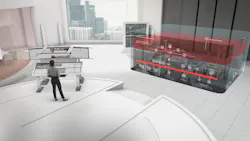
In light of this industry reality, we wanted to explore ABB's new Automation Extended program, which ABB calls “a new approach” to automation, designed to resolve the apprehension around advancing industrial operations without interfering with them by creating two environments. These environments are designed to separate stable, real-time process control from more flexible and evolving digital capabilities while keeping both securely integrated.
In a recent episode of the “Automation World Gets Your Questions Answered” podcast series, we connected with Stefan Basenach (SB), senior vice president of automation technology at ABB, to help us understand what Automation Extended is and how and why this new technology's ecosystem approach works in practice.
AW: Automation Extended is described as an evolution of ABB's distributed control systems. Can you walk us through what makes this significant for industries using heritage distributed control systems today?
SB: Automation Extended is the first step of our implementation of the Automation Vision white paper we published four years ago where we described our vision about automation systems for the future. With ABB’s large active user base, we often work closely with our customers and discuss how to run their plants effectively for decades, while continuously driving innovation. The innovation space is getting more and more important because our customers are facing new challenges in the market. So, combining those two capabilities in one architecture is what Automation Extended is really all about.
Automation Extended provides a way to create a safe connection point between the digital and core control environments, where a new setpoint developed by AI to improve the core control loop’s algorithm can be safely passed to the core control system without changing the control loop itself.

AW: The automation ecosystem in Automation Extended features a separation between the control environment and the digital environment. Can you explain these two separate environments and why you see this architectural choice as critical in terms of what problems it solves compared to traditional DCS architectures.
SB: Automation Extended is redefining the decentralized control system architecture. We understood from our customers that having stable, reliable core control is very important, but they also need to innovate on the digital side. This is why we came up with the idea of building an ecosystem where those two environments co-exist and are linked with a well-defined interconnection that is interoperable but also safe. For this connection we use the NAMUR Open Architecture standard which ensures that the core control is always protected. With this, no application, service or interference from a digital environment can harm the reliable core control part. This is a simple step, but it represents a key difference for Automation Extended: combining those two environments with consistent lifecycle management. Even though these environments are separate, they are managed from one holistic platform, they are both treated like a distributed control system with one management portal. This is what makes a big difference for the end user.
AW: To clarify the digital environment capabilities in Automation Extended, I understand that it's been designed to enable the use of AI condition monitoring and predictive maintenance as well as alarm management, augmented operator decision support and remote operations without impacting the core control functions. Can you explain how that works and how a company could deploy these types of functions incrementally since each of these advanced capabilities are still relatively new for many industrial companies.
SB: The digital application used in Automation Extended has existed for decades and was typically applied by creating a kind of bilateral communication. This meant you always had to touch the core control to connect a digital application at the edge. But doing this could be very difficult and it opened up the possibility for errors to be made; plus it was not secure. What we have changed now with Automation Extended’s core control and digital environments is to join them via connection points that are NAMUR Open Architecture qualified. This means you can plug in any digital application that supports this standard and use the intrinsic existing connection that is part of Automation Extended. That means this bilateral communication exchange is no longer needed and you're always sure that your digital application cannot harm the core control. You don't need to touch the core control and, through the management portal, you can manage the digital applications at all times. You can switch them on and off, download patches and add additional features without disturbing the core control environment. That's the important point.
Automation Extended’s central lifecycle management allows you to download patches as needed to different devices connected to the system — even to devices in the field, like intelligent field instruments.
AW: Just to clarify, you’re saying that, by keeping the core control functions as they are and layering the digital applications on top of it, you are able to ensure the dependability and reliability of the core control functions.
SB: Yes, and we did this by following the requests of the customers, because the core control is an automation logic that has often gone unchanged in their operations for decades. Some companies have implemented more automation than others, but in both cases the control loops have largely remained unchanged, because that’s not something you want to disturb. With Automation Extended you don't have to. For example, Automation Extended provides a way to create a safe connection point between the digital and core control environments, where a new setpoint developed by AI to improve the core control loop’s algorithm can be safely passed to the core control system without changing the control loop itself. In this process, humans remain a critical part of the loop and must approve the algorithm change before it’s implemented.
AW: Since most industrial companies are sitting on decades of automation investments, can you explain how Automation Extended allows them to update their control system without having to rip and replace their existing architecture?
SB: With our ABB Ability™ System 800xA® distributed control system, the operator is always in charge of how the control system is manipulated. Because System 800xA has long served as an integration platform, the connectivity services are already built into 800xA and can be used even with our heritage control systems. Now we're taking the next step where we shrink the 800xA operation down to the core control layer and we’ve created a shell around this core control that provides the connectivity to the digital environment. With our latest long-term release, System 800xA 7.0, we’ve established this stable core control together with a shell that opens the door for Automation Extended functionality. To take the first step into Automation Extended, you don't need to change your core control, you simply update the 800xA operation system and the door is open for future innovation.
Even though these environments are separate, they are managed from one holistic platform, they are both treated like a distributed control system with one management portal. This is what makes a big difference for the end user.
AW: Cybersecurity is, of course, a major concern when it comes to connecting control systems in any way to a networked environment. What are the key security principles built into the Automation Extended architecture?
SB: Automation Extended is built on open standards that are designed to be cybersecure from the beginning. All our connection points use OPC UA as the standard communications protocol and the secure NAMUR Open Architecture for the interoperability layer between the control environment and the digital environment. Automation Extended’s central lifecycle management allows you to download patches as needed to different devices connected to the system — even to devices in the field, like intelligent field instruments. The idea is that all aspects of lifecycle management, including patches, are part of the system. It’s not an add-on application, it's built into the system as part of Automation Extended’s functionality. We have also implemented certification management in all our systems. This means that partners in the network can only communicate to each other if they have the relevant and valid certifications available. In this way, users don’t have to replace everything to access these capabilities. Their heritage control system can co-exist with these new digital features. This kind of flexibility is at least as important as the technology itself.
Listen to the full podcast discussion with Stefan about on ABB Automation Extended.
Use this QR code to learn more about ABB's Automation Extended: 
About the Author
 David Greenfield
 Leaders Logo
Leaders relevant to this article: