Three Industrial AI Trends Reshaping Manufacturing Automation In 2027
Key Highlights
- AI can flag costly design issues early and adjust production processes in real time to prevent defects.
- Spatial AI keeps digital plant models current and helps mobile robots navigate shared, changing environments.
- Physical AI is making robotics more adaptable to high-mix production, though early deployments remain supervised and task-specific.
- Manufacturers can bridge the pilot-to-production gap by starting with measurable problems and building reliable machine data.
- Clear operating limits, operator oversight, cybersecurity and workforce training are essential to scaling safely.
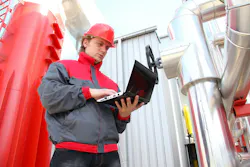
Manufacturers entered 2026 with no shortage of AI enthusiasm, yet a recent survey found that 72% have adopted AI in some form while only 10% have deployed it at scale. Labor pressure adds urgency, since as many as 1.9 million manufacturing jobs could go unfilled through 2033 if workforce gaps persist. Together these forces are moving the conversation away from isolated software pilots and toward systems that decide and act on the factory floor, and three shifts are likely to shape competitiveness over the next 12 to 18 months.
Quality moves upstream and corrects itself
The highest return AI applications are shifting toward the start of the product life cycle, where more than 70% of a part’s cost can be locked in before manufacturing and sourcing teams have much room to respond. Tools that read part geometry can flag thin walls, undercuts and tolerances tighter than the application requires, then estimate cost drivers before tooling is quoted, which turns an expensive tooling revision into an inexpensive design conversation. For plants quoting dozens of new part numbers each month, automating that review also shortens quoting cycles and frees experienced engineers for harder problems.
On the shop floor, attention is moving from detecting defects after a process finishes to preventing them while it runs. Closed-loop quality control sends measurements from vision systems, metrology and sensors back to the machine controller, which can adjust feed rates, thermal limits or injection pressures in real time, and some deployments report up to a 25% decline in scrap costs. The strongest implementations define limits on what the system may change, allow operator override and log every adjustment, which preserves the traceability that regulated sectors require.
Spatial AI extends the digital twin
Static digital twins have served planning well, but they tend to be rule driven, costly to build and brittle when conditions change. Spatial AI addresses part of that gap by building a continuously updated 3D model of the plant from cameras and LiDAR, so operations leaders can test a schedule change or layout adjustment against live floor conditions instead of last quarter’s survey. Because the model updates as equipment moves and layouts change, it also keeps simulation closer to actual conditions, which supports faster decisions about line balancing and material flow.
The same perception capability matters for mobile robots in older plants, where cracked floors, unpredictable lighting and tight aisles often lead manufacturers to assume that beacons or reflectors must be installed before automation can work. Infrastructure free navigation changes that assumption, and at one automotive site more than 480 autonomous mobile robots operate alongside hundreds of manually driven forklifts without floor markers. Intent prediction adds another layer by anticipating where a forklift or worker is headed, which allows robots to yield smoothly in shared aisles rather than stopping at every obstacle.
Physical AI takes on variable work
Conventional robot cells perform well when parts and fixtures never change, which explains why automation has struggled in high mix, low volume production, where much of manufacturing value is created. Advances in physical AI are enabling adaptive robotics that replace hard coded systems, allowing a cell to handle part variation through perception and learned behavior rather than a new programming project for every changeover. Foundation models trained on large volumes of manipulation data give these systems a starting level of competence that integrators then tune for a specific plant, which shortens the path from installation to productive work.
Early trials show the direction of travel, including one pilot in which a humanoid robot handled 90,000 components at a U.S. automotive plant. These deployments remain bounded and carefully supervised, so they are best read as evidence that adaptive systems can work in human designed spaces rather than proof that general purpose robots are ready for every task.
Closing the gap between pilot and production
The technology is advancing faster than the foundations beneath it, and 48% of industrial respondents cite legacy system integration and data silos as a top barrier to adoption. Manufacturers that scale successfully tend to begin with one line that has measurable scrap or changeover pain, build clean and time stamped machine data before adding models, and decide in advance what each system may adjust on its own and who owns the outcome.
Workforce planning belongs in the same conversation, because operators who supervise autonomous systems need different skills than those who chase alarms. Cybersecurity and operational disruption also deserve early attention, since systems that write to machine parameters expand the attack surface and raise the consequences of a bad decision. Expanding only after a narrow deployment has proven stable for several months keeps risk manageable, and it gives plants the evidence needed to move from experimentation to a repeatable operating model.
Taken together, these shifts point to a factory that treats data as an input to action rather than a record of what already happened. Manufacturers that connect design intelligence, spatial awareness and adaptive machines on a stable data foundation will be better positioned to absorb labor constraints and demand swings, while those that keep piloting in isolation risk watching the gap widen.
About the Author
 Dijam Panigrahi
Dijam Panigrahi is co-founder and COO of GridRaster, a spatial computing platform for industrial enterprises and manufacturers. For more information visit www.gridraster.com.


 Leaders Logo
Leaders relevant to this article: